
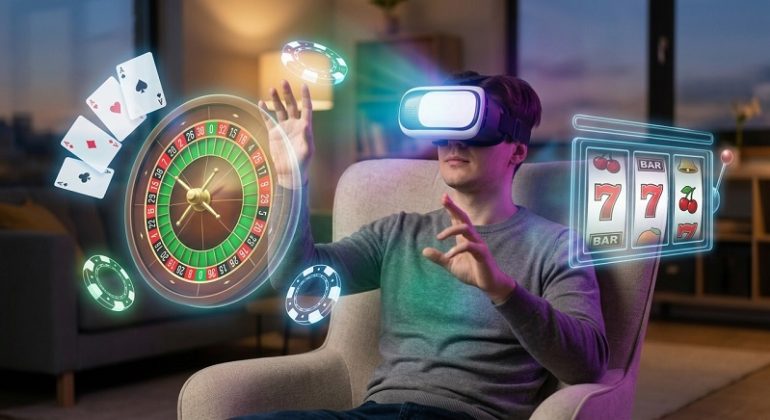
The traditional casino floor is an assault on the senses in the best possible way. The distinctive clatter of clay chips, the muffled shuffling of cards, the low ambient hum of hundreds of conversations, and the striking architecture all combine to create an environment purely engineered for entertainment. For the past two decades, the digital gaming industry has attempted to capture this lightning in a bottle. While online platforms successfully delivered the mathematical mechanics of wagering to smartphones and desktop monitors, they fundamentally failed to export the atmosphere. Clicking a mouse or tapping a piece of glass is convenient, but it is a sterile, solitary experience.
Virtual reality is rapidly dismantling this limitation. By shifting the digital casino from a flat, two-dimensional interface into a fully immersive, 3D spatial environment, operators are no longer just offering games; they are building digital resorts. The integration of VR into casino entertainment represents the most significant shift in the gambling industry since the advent of the internet, fundamentally altering how players interact with games, the house, and each other.
The Evolution from Static Interfaces to Spatial Environments
If you evaluate a standard online casino application today, the architecture is entirely transactional. You log in, select a game from a grid of thumbnails, and stare at a digital table or a spinning reel. The brain processes this as interacting with a software program. Virtual reality changes the psychological paradigm. When you put on a high-fidelity headset, you are no longer playing a game on a screen; you are stepping inside the game.
This shift to spatial computing introduces tangible mechanics to digital wagering. Instead of clicking a button labeled “Deal,” a player can reach out, grasp digital chips with their own hands using haptic controllers, and physically slide them across the felt. They can pick up their hole cards, peel the corners back to peek at their hand, and toss them into the muck. This physical engagement triggers a visceral response that two-dimensional applications simply cannot replicate. The illusion of presence tricks the brain into treating the digital environment with the same emotional weight as a physical room in Las Vegas or Macau.
Rebuilding the Social Dynamics of the Casino Floor
The most glaring casualty of the online gambling boom was the social dynamic. Wagering has historically been a communal activity. The shared tension around a roulette wheel as the ball bounces through the pockets, or the collective celebration at a craps table when the shooter hits their point, is what keeps players engaged. Online platforms isolated the player. VR is actively rebuilding the bridge between convenience and community.
Avatars and Non-Verbal Communication
In a virtual reality casino, you are represented by an avatar, and you are surrounded by the avatars of players from around the world. Because modern headsets utilize highly accurate head and hand tracking, the non-verbal communication that is so critical to the casino experience returns to the digital space. You can nod to the dealer, physically turn your head to converse with the person sitting in the next seat, or watch a rival player at the poker table aggressively push their stack forward.
The Implementation of Spatial Audio
To sell the illusion of a crowded casino floor, developers rely heavily on spatial audio. This audio technology anchors sound to specific physical locations within the virtual environment. If a player to your left celebrates a blackjack, the sound hits your left ear exactly as it would in reality. As you walk away from the table and toward the virtual lobby, the sounds of the chips fade smoothly behind you, replaced by the ambient music of the digital resort. This acoustic mapping is what ultimately cements the feeling of actually being in a room with other human beings.
Elevating the Psychology of Table Games
While slot machines dominate the revenue sheets, table games are the psychological heart of any casino. Bringing games like poker and blackjack into virtual reality fundamentally changes the strategic depth of online play.
In traditional online poker, a player’s strategy is largely mathematical, based on betting patterns, timing, and pot odds. Because you cannot see your opponents, the psychological meta-game is severely handicapped. VR poker resurrects the physical “tell.” Even with digital avatars, a player’s physical movements give away vital information. You might notice a player rapidly checking their hole cards when the flop is dealt, or you might spot the subtle hesitation in their hand movements before they place a massive bet. Some VR headsets are already incorporating eye-tracking technology, which means in the near future, the direction of an opponent’s digital gaze could reveal whether they are staring at the pot or anxiously glancing at the exit. This brings the raw, human element of deception and observation back to the digital felt.
The Transformation of the Slot Machine Experience
Slot machines have always relied on visual and auditory stimulation to maintain player engagement, but VR allows developers to completely discard the physical limitations of a cabinet. In a virtual environment, a slot machine does not have to be a box sitting in a row; it can be an entire explorable world.
Instead of watching a screen featuring an Egyptian theme, a VR slot player can be transported into the center of a Pharaoh’s tomb. When a bonus round is triggered, the walls of the tomb could fall away, requiring the player to physically reach out and grab falling artifacts to determine their multiplier. The reels themselves can float in three-dimensional space, surrounding the player with high-definition animations and volumetric effects that would be impossible to engineer on a physical casino floor. By turning the act of spinning reels into a narrative-driven, interactive journey, developers are creating an entirely new category of casino entertainment that appeals heavily to younger demographics accustomed to complex video game environments.
Navigating the Hardware and Adoption Hurdles
Despite the incredible potential, the widespread adoption of VR casino entertainment is not without friction. The industry remains constrained by the hardware itself. Early iterations of virtual reality headsets were heavy, required tethering to expensive gaming computers, and frequently induced motion sickness due to low refresh rates.
However, the hardware ecosystem is evolving at a breakneck pace. The emergence of standalone, lightweight headsets has drastically lowered the barrier to entry. Furthermore, the advent of cloud rendering is allowing the heavy graphical processing to take place on remote servers rather than on the headset itself, meaning players can experience photorealistic casino environments without needing a multi-thousand-dollar computer setup. As the hardware becomes as ubiquitous and user-friendly as the smartphone, the migration from 2D betting apps to VR casino resorts will accelerate exponentially.
The Regulatory and Security Landscape of the Metaverse
Operating a virtual casino requires navigating a complex and fragmented global regulatory environment. Regulatory bodies that govern traditional online gambling are currently scrambling to adapt their frameworks to accommodate spatial computing.
One of the primary concerns is enforcing Know Your Customer (KYC) protocols and age verification in a world populated by avatars. Operators must ensure that the person behind the headset is legally permitted to gamble and is physically located in a jurisdiction where online wagering is legal. This will likely require the integration of advanced biometric security, tying a user’s real-world identity to their virtual presence through fingerprint scanning or iris recognition built directly into the headset hardware.
Additionally, responsible gaming protocols must be entirely re-engineered for the VR space. Because virtual reality is designed to be deeply immersive and block out the physical world, players can easily lose track of time and financial limits. Operators are developing built-in reality checks—subtle visual cues or digital wristwatches on the player’s avatar—to ensure that the immersion does not lead to harmful betting behavior.
The integration of virtual reality into casino entertainment is not a passing novelty; it is the inevitable evolution of the industry. It bridges the critical gap between the convenience of digital wagering and the thrilling, social atmosphere of physical casino resorts. As the hardware continues to refine and the development studios push the boundaries of spatial design, the digital casino floor will become a destination in its own right—a place where players do not just place a bet, but step entirely into another world to experience the ultimate rush of the game.
